← All guides · October 6, 2026 · 7 min read
What to Post When You Have No Listings: 20 Ideas With Finished Examples
No inventory is not a content problem. 20 post ideas that need no listing — local expertise, market explainers, spotlights, education and trust posts — each with a finished example.

Every agent hits the stretch: the last listing closes, the pipeline is conversations and maybes, and the feed goes quiet because there is "nothing to post". That quiet is expensive — sellers choose the agent they have been watching, and a silent feed reads as an agent who has left the business. But listings were never your only material. Your expertise, your streets and your voice are inventory too.
When you have no listings, post what listings never gave you anyway: local knowledge, plain-English market explanations, community spotlights, buyer and seller education, and trust-building glimpses of how you work. None of it needs inventory, all of it compounds, and three posts a week — one of each kind — keeps you the obvious local agent.
Why does posting with no listings matter?
Because the audience decides before the appointment. A homeowner selling next spring follows three agents for months; the one who kept teaching and kept showing the neighbourhood gets the call. Posting through the dry stretch is not filler — it is the audition for your next five listings. Every idea below takes minutes, in your own words, no property required.
Local expertise posts
1. The price-band explainer
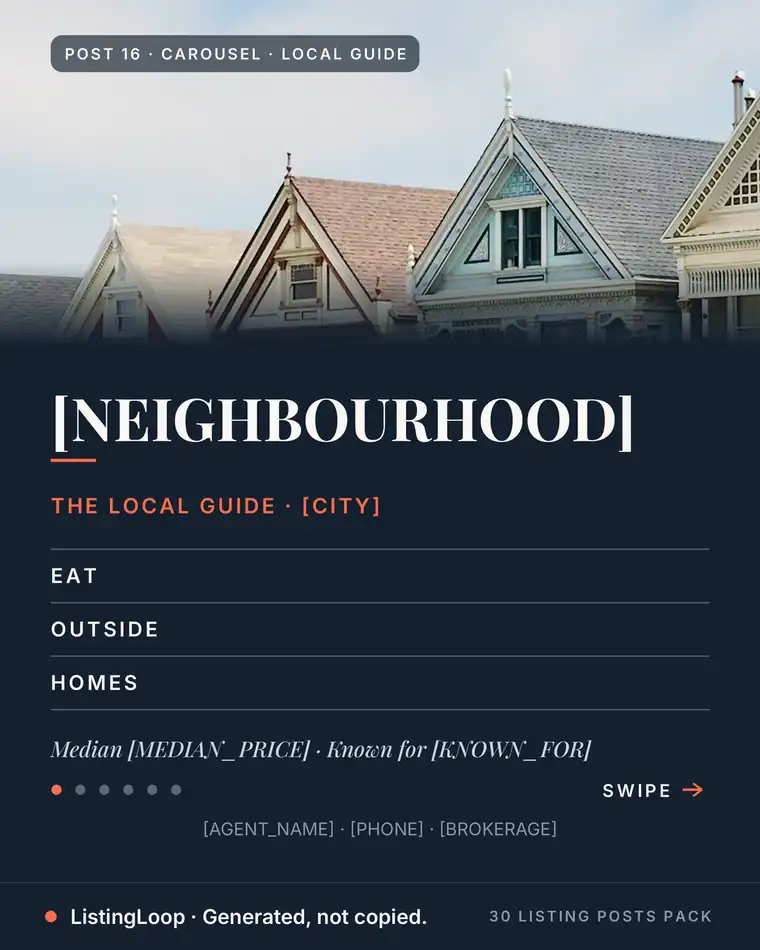
Explain what each price band actually buys in one area right now — your MLS's current figures, dated in the post.
What does $[band] buy in [Neighbourhood] this month? At the moment: [beds]-bed homes on [street type], usually [lot/feature fact]. $[Next band] is where [feature] starts appearing. Numbers from [MLS/association], [month] — they move, so ask me for this week's version.
2. Three changes on one street
New construction, a renovation, a business opening — factual changes you have seen yourself.
Three things changing on [Street] this month: 1) The [development] broke ground at [location]. 2) [Business] opens its doors [date]. 3) The [civic project] finished ahead of schedule. Streets tell you where a market is heading before the stats do.
3. The weekend guide
A short, factual guide to what's on locally this week.
This weekend in [Area]: [event] at [venue], [day] [time] · [market/fair] at [location], [day] · [free/cheap highlight]. Save this for Saturday morning. Which one are you picking?
4. One street, one story
A verifiable piece of local history about a street or building.
[Street] wasn't always [current fact]. In [year], [historical fact — check your local archive before posting]. The [building/landmark] at [location] is the last piece of that era still standing. Your city has layers — knowing them is the job.
Market explainers, in plain English
5. What "days on market" actually tells you
"Days on market" sounds like a verdict. It isn't. It tells you how a home was priced against its competition on day one — nothing about the home itself. A well-priced home in [City] is currently moving in about [X] days [source, month]. Long time listed usually means the price met the market late, not that the house failed.
6. Rates moved — what it means in real money
Translate rate news into a monthly-payment illustration, labelled as an estimate, with your source and date.
Rates moved [direction] this week [source, date]. In plain English: on a $[amount] loan, that's roughly $[X] a month difference versus last month — estimates only, not financial advice, and your lender's number is the real one. The point: small moves change monthly comfort more than headlines suggest.
7. List price vs sale price, explained
The list price is a strategy, not a promise. In [City] last month, homes sold at [X]% of asking on average [MLS, month]. Some were priced to invite competition; some were priced to sit. When you see a number, ask which strategy it is — or ask me.
8. "Balanced market", translated
You'll hear "balanced market" this month. It means neither side has the whip hand: buyers can negotiate repairs again, and sellers who price for last year wait. In [City] we have about [X] months of inventory [source, month] — under 3 is a seller's market, over 6 is a buyer's. Now you can read the headline yourself.

Skip the blank caption box
The free Listing Post Generator writes this exact kind of post from your listing details — your city, your numbers, your name — in about 20 seconds. Caption 1 is instant; all three captions plus hashtag sets unlock with an email.
Try the free generator →Community and business spotlights
9. The two-minute business interview
Ask a local owner three questions; post their best answer in their words.
I asked [name] at [business] what surprises people about [trade/product]. Their answer: "[quote — with permission]." [Business] has been on [Street] for [X] years. Go and say hello — and tell them a neighbour sent you.
10. New business on the block
New on [Street]: [business] opened [day] at [location]. They do [what, factually]. First impressions: [one honest detail]. New businesses are a street investing in itself — worth celebrating, worth visiting.
11. The event recap
[Event] yesterday at [venue]: [turnout/atmosphere fact], [one moment], [one person/group worth crediting]. This is the part of [Area] you can't put in a listing description — you had to be there. Next one's [date]; see you there.
12. Who I call
Recommend one local service you genuinely use — trust transfers.
The number in my phone for [trade] emergencies: [name/business], [area]. They've handled [type of job] for three of my clients this year — fast, fairly priced, tidy. Save this post for the day you need it.
Educational buyer and seller series
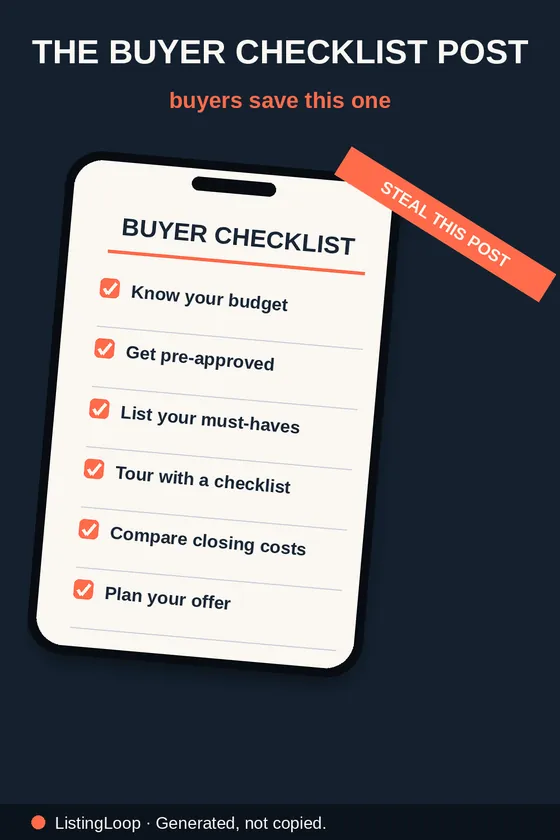
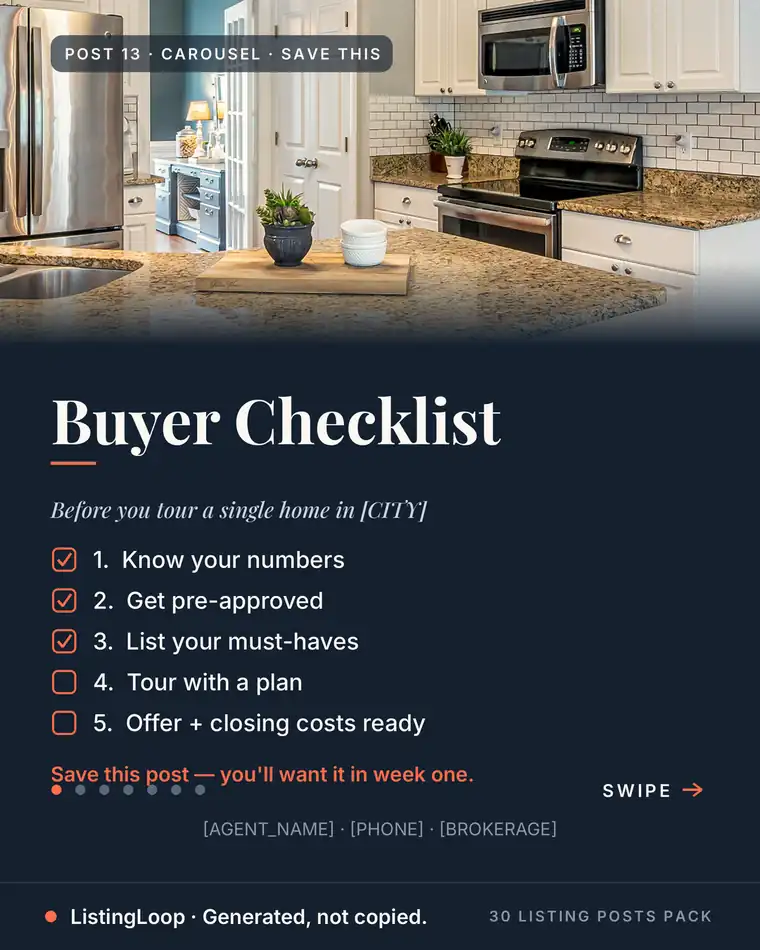
13. Before you tour: the pre-approval post
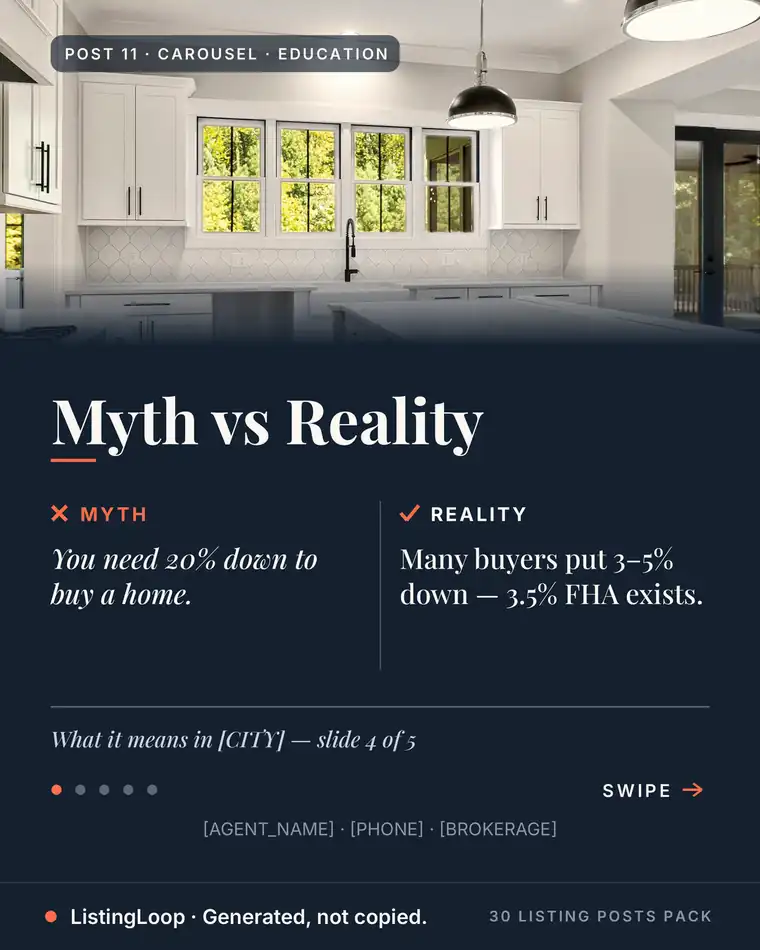
Step one of buying isn't touring — it's knowing your number. A pre-approval tells you what a lender will actually lend, which changes which homes you should look at. It costs nothing but a conversation, and it makes your eventual offer stronger. Questions about the order of steps? My DMs are open.
14. The pricing-from-emotion mistake
The most expensive seller mistake I see: pricing the memories instead of the house. Buyers pay for beds, condition and street — not for the birthdays held in the kitchen. Price for the market you're in, and the market pays you back in pace. (How I'd price yours: happily shown, free, no obligation.)
15. After the offer is accepted — what happens next
Offer accepted — then what? Earnest money goes in [typical local practice]. Inspection happens within [X] days. Appraisal is ordered by the lender. Then it's paperwork until closing day. Nothing about it is mysterious once someone walks you through it — that's most of my job, honestly.
16. The costs beyond the price
The price is not the whole cost of buying. Budget also for: lender fees, title and escrow charges, prepaid insurance and taxes, and moving. Together they often land around [X]% of the price — estimates only, and your lender's worksheet has the exact figures. Knowing before you offer is the whole game.
Personal brand and trust posts
17. Why I work in [City]
People ask why I base my business in [City]. Simple version: [one true, specific reason — a street, a market trait, a community fact]. I know which blocks flood with enquiries and which sit. That knowledge is the product. The houses are just where it gets used.
18. Behind the scenes: how I price a home
Pricing day looks like this: pull the last [X] comparable sales, walk the house for condition the data can't see, then argue with myself about the buyer pool at three different prices. The spreadsheet is the easy part. This judgement is what you're hiring.
19. A lesson from a past deal
Tell one anonymised lesson — a situation and what it taught you, with no invented results.
A deal once taught me [lesson] the hard way: [situation in two lines, no names, no figures you can't stand behind]. Now I [the practice it changed]. Experience is just a collection of these — happy to share mine before you need your own.
20. FAQ Friday
Most-asked question this week: "[a real question a client or follower asked]." Short answer: [two or three plain sentences]. Longer answer in my stories today. Drop next week's question in the comments.
What does a sustainable week look like?
Three posts, three different jobs, repeatable for months without a single listing:
- •Monday — market or education: one explainer from groups 2 or 4. You are the translator.
- •Wednesday — local: one post from group 1 or 3. You are the neighbour who knows.
- •Friday — trust: one post from group 5 (FAQ Friday runs itself). You are the professional they'd call.
Batch them in one sitting on Sunday and the dry stretch stops feeling dry. For the full month view — how these rotate against listing posts when inventory returns — the content calendar for realtors lays out the same rhythm across 30 days.
No listings is a season, not a verdict — and the agents who post through it come out of it with the audience. Write these yourself with the formulas above, and when the listings do land, the free Listing Post Generator turns their details into finished captions in minutes. If you'd rather have a month of posts assembled in this same mix — education, local, trust and listing posts — the 30 Listing Posts Pack is built exactly that way, for $17 once; check the pricing page for what's included and current availability.
Want the month done for you?
The 30 Listing Posts Pack: a full month of posts — finished graphic, written caption, hashtag set and posting prompt on every one. $17, one time. No subscription.
Written by the ListingLoop team — we build the free Listing Post Generator and the 30 Listing Posts Pack. Everything in our guides is the same system we sell, explained in the open: if a guide stops being useful without a purchase, we have written it wrong. Everything we sell sits in one place — see the Agent Content System — full pricing.