Choose a post that matches what you have today. The first five sections contain ten finished examples each. The final four are seasonal ideas. Replace example prices, dates and addresses with verified details before publishing.
Pick a post for today
- •A listing just went live. Start with one feature you can show in a photo. Use the listing caption generator to turn the address, price and feature into a first draft.
- •An open house is this weekend. Start with the date, local time and address. Use the open house caption examples for the invitation and reminder.
- •You have no active listings. Answer a question a buyer asked this week. The no-listing post ideas include sample answers.
- •You need a week of posts. Pick one example from each of the first five sections and assign it a day in your weekly content calendar.
Job 1: Sell the listing (without sounding like the MLS)
Listing posts still matter — they are why sellers hire you. The rule: lead with the story or the single best feature, never the full spec sheet. Specs belong in the link; the caption’s job is to make someone stop scrolling — and when it closes, the just sold captions take over.
Every listing format in this section starts from the same three parts — hook, specifics, one call to action. The free Listing Post Generator writes them from your listing details in about 20 seconds; the examples below show what comes out.
- •The story-led Just Listed. “Saturday mornings in this kitchen look like this: coffee on the counter, light through the east windows, nowhere to be until noon. 123 Maple Street, Austin — 3 bd · 2 ba · $425,000. Open Saturday 11–1. DM me TOUR for the details.”
- •One feature, full post. “The covered deck is the whole post. Shaded by two, dry in the rain, big enough for the table and the grill. It comes with a 3-bed house at 123 Maple Street — $425,000. Tours from Thursday; link in bio.”
- •The price-drop reframe. “New price on Maple Street: $425,000. Same house, new math — at [x]% over 30 years, the principal-and-interest payment works out near $[x]/month (estimate only — not financial advice; taxes and insurance are extra). Open Saturday 11–1.”
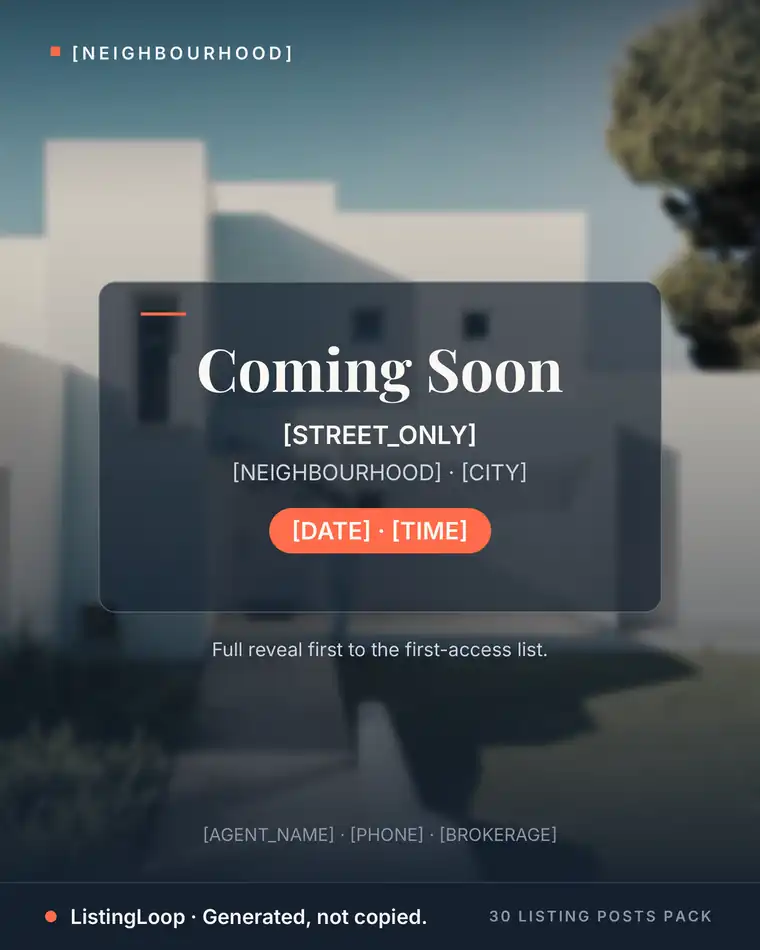
- •The coming-soon teaser. “Something with a covered deck and a garden lot is coming to Maple Street this week. One photo now; the rest on Thursday. Comment FIRST and I’ll send the details before it lists.”
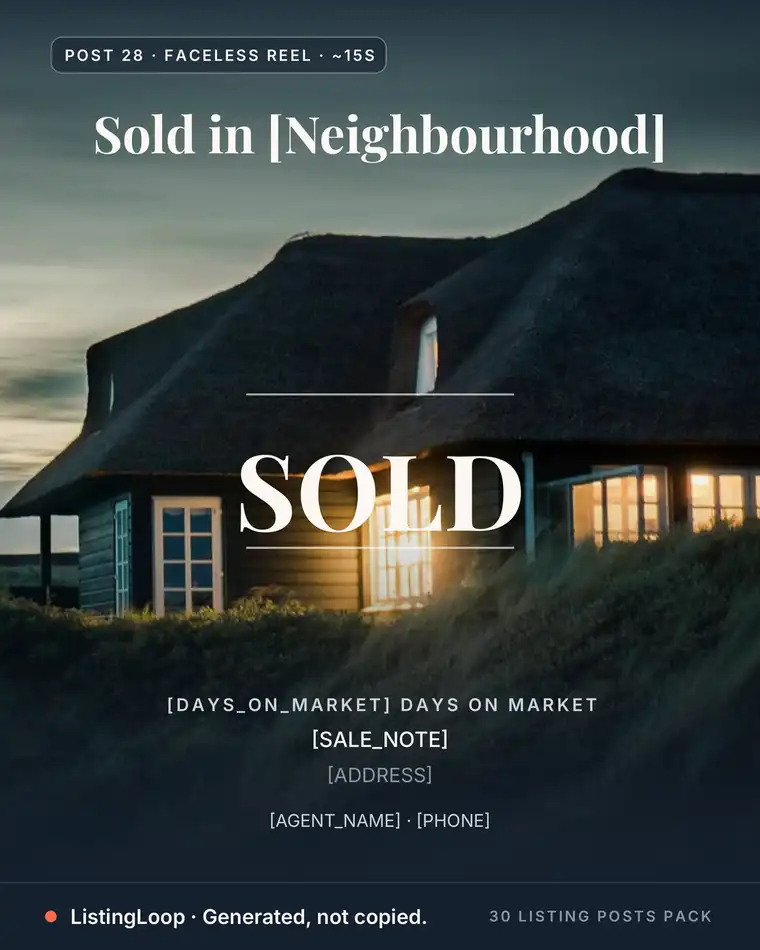
- •Sold, with the story. “Sold on Maple Street. Fourteen days, [number] tours, and every single visitor asked about the deck. Selling on this street next? DM me SOLD for what this result means for your price.”
- •The open house invitation. “OPEN HOUSE — Saturday, 11–1. 123 Maple Street, Austin · $425,000 · 3 bd · 2 ba · updated kitchen. No appointment, no pressure. Come and stand in the kitchen and decide for yourself.”
- •The numbers post. “The numbers on Maple Street: $425,000 · 3 bd / 2 ba · [lot size] · recent rents on this street around $[x]/month (agent-collected — ask me for the sheet). DM me NUMBERS for the full breakdown.”
- •Back on the market. “Back on the market at 123 Maple Street — the buyer’s financing fell through; the house didn’t change. $425,000, tours from tomorrow. Second looks welcome: DM me TOUR.”
- •The new-build post. “Framing is up on [street]. Early enough and the finishes are still your choice: 4 bd / 3 ba from $[price], completion [month]. DM me BUILD for the floor plans.”
- •The land post. “A [0.4]-acre lot on [street], utilities at the road, priced at $[price]. Build, hold, or split — the options are the pitch. DM me LAND for the parcel details.”
Job 2: Prove expertise (the posts that get saved)
Education posts are the ones people save, and saves are what keep a post circulating for weeks. Content-mix frameworks have long recommended a 4-1-1 rhythm — for every promotional post, publish several that simply inform. This is the “inform” pile, and it is where future clients come from.
- •Myth vs reality. “Myth: you need 20% down to buy a home. Reality: low-down-payment loans exist, and some buyers close with 3–5% down. What changes is the monthly payment and the mortgage insurance — run both versions before you rule yourself out.”
- •Real numbers. “What $425,000 costs per month: at [x]% over 30 years, principal and interest comes to about $[x] (estimate only — not financial advice; taxes and insurance vary by property). Notice what moves the number most: the down payment, not the rate. Save this for budget night.”
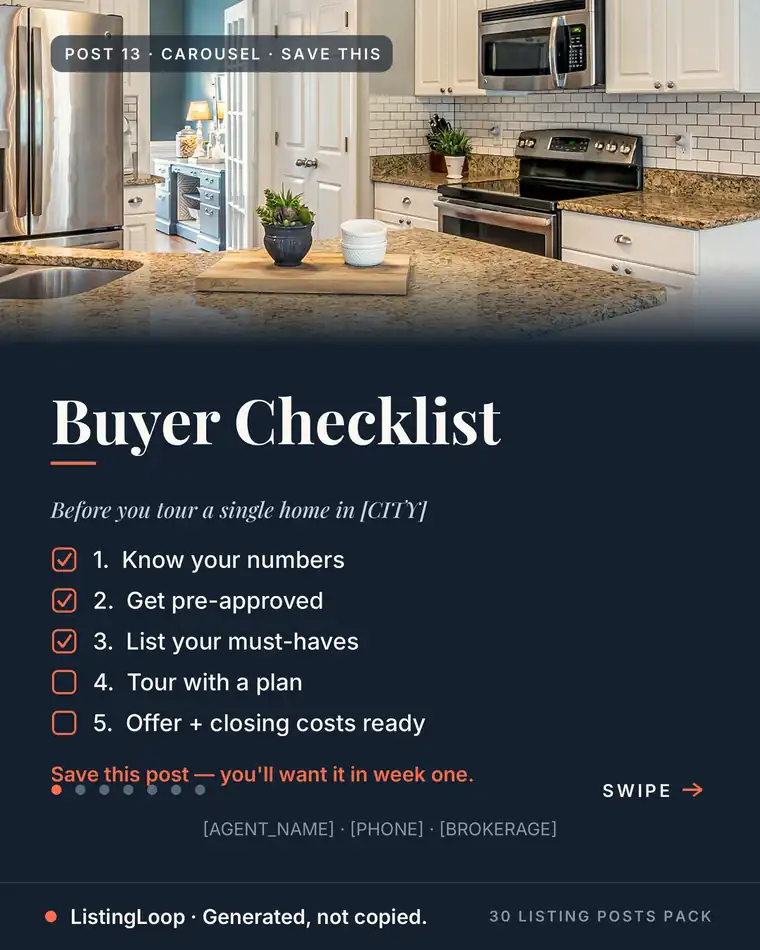
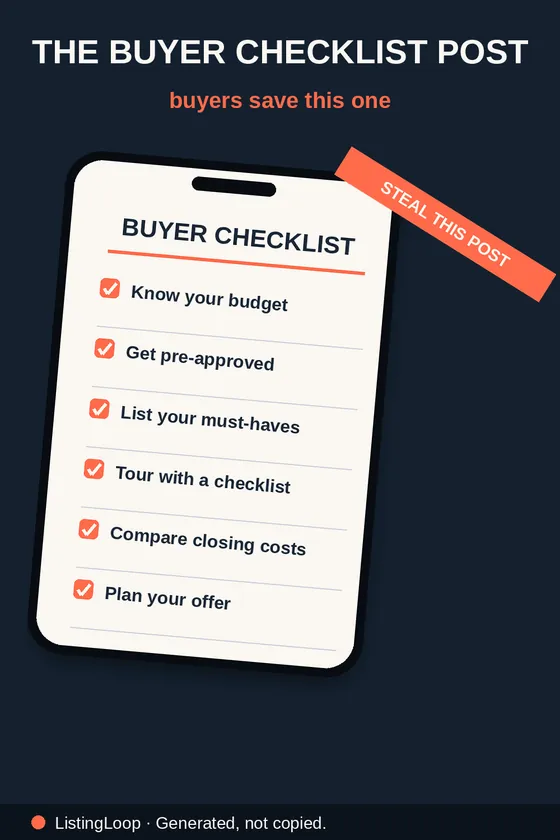
- •The buyer checklist. “Before you make an offer in [city], have five things ready: 1) your pre-approval letter, 2) proof of funds for the deposit, 3) your maximum monthly payment, in writing, 4) your deal-breakers list, 5) a 24-hour decision plan. Offers move fast; paperwork shouldn’t be the delay.”
- •The seller mistake. “The listing photos were shot before the declutter, and the first weekend paid for it. Full rooms photograph small. Move the boxes first, then book the photographer — the order matters more than the camera.”
- •Answer the question you got this week. “A buyer asked me this week: ‘Can I make an offer before my own place sells?’ Short answer: yes — with a sale contingency, a bridge option, or a longer close. Each costs something different. Here’s the plain version of each…”
- •One market stat, your take. “One number from [city] this month: homes that sold took a median of [x] days (per [source]). What it means in practice: correctly priced listings still move in the first two weeks. The strategy is the launch, not the wait.”
- •Pre-approval vs pre-qualification. “A pre-qualification is an estimate. A pre-approval is a verified file a seller can lean on. On a multiple-offer weekend, that difference is the whole game. Get the second one before you book a single tour.”
- •The inspection, reframed. “An inspection is not a pass/fail test. It’s a priced list of what the house needs, in order. Read it as a budget, negotiate the big items, let the small ones go — that’s how deals stay together.”
- •Closing costs, plainly. “Closing costs are the fees around the mortgage — lender, title, taxes, insurance — usually a few percent of the price, and itemised in an estimate before you sign anything. Ask for that estimate early. Surprises at the closing table are a planning failure, not a normal cost of buying.”
- •How pricing actually works. “Pricing a home is not picking a number you’d like. It’s reading the last five comparable sales and choosing where in that range your launch week works hardest. Price over the range and you don’t ‘leave room to negotiate’ — you leave the listing sitting while the market moves on.”
Skip the blank caption box
The free Listing Post Generator writes this exact kind of post from your listing details: your city, your numbers, your name, in about 20 seconds. Caption 1 is instant; all three captions plus hashtag sets unlock with an email.
Try the free generator →Job 3: Claim the local ground
National content competes with everyone. Local content competes with almost nobody — and it is the content a relocating buyer actually searches for. This is the pile that makes you the obvious agent for your streets, not just an agent.
- •Neighbourhood spotlight. “[Neighbourhood] in one post: [1940s bungalows] on deep lots, a Saturday farmers market at [street], and three sales last month between $[x] and $[x]. Describe the place and the properties — that’s the whole job. This is the ground I work.”
- •Local business feature. “Friday appreciation: [bakery name] on [street]. The morning bun is worth the trip and the people behind the counter are worth knowing. Businesses like this are why people move to [neighbourhood] — and why they stay.”
- •What $[price] buys in [city]. “What $425,000 buys in [city] this month: in [neighbourhood A], a 3-bed with a garden lot. In [neighbourhood B], a 2-bed condo near the centre. In [neighbourhood C], land and a plan. Same money, three different lives. Which one is yours?”
- •Walk the block. “Thirty seconds on [street]: coffee at [café], the park gate, the bus stop — and the house at number [x] that just listed. This is the walk its buyers will do every morning. (Caption for the walking video; the street does the talking.)”
- •This weekend in [city]. “This weekend in [city]: [event] on Saturday morning, [event] at [venue], and an open house at 123 Maple Street, 11–1. Save this — weekend plans and house-hunting in one post.”
- •The park post. “[Park name] at 7am: [number] acres of trails, courts and open grass, and the Saturday league warming up. Homes back onto this park — my listing at [address] is one of them. This is a feature no floor plan shows.”
- •New on the street. “New on [street]: [shop / restaurant] opens [day]. Every new business on a street is a data point about where a neighbourhood is heading. Welcome to [neighbourhood], [business name] — the street’s glad you’re here.”
- •The commute, honestly. “From [neighbourhood] to [centre]: [x] minutes by car at 8am, [x] by the [line] train, [x] by bike on [route] (times checked by me, [month]). Every listing I post here will carry the real numbers, not the brochure version.”
- •The local history nugget. “[Street] was laid out in [year], and the [original feature] is still standing on the corner of [street]. The houses around it have changed owners, not architecture. History is a feature — I list it like one.”
- •The micro market update. “[Neighbourhood] this week: [number] new listings, [number] price changes, [number] sold. The pattern I’m watching: [one plain observation]. Street-by-street version — comment REPORT and I’ll send it.”
Job 4: Build trust (the posts sellers choose you from)
Sellers rarely pick the agent with the most listings on their feed. They pick the one whose feed showed them how they work. Trust posts feel personal, but each one follows a structure.
- •Testimonial, done properly. “‘[The client’s own words, used with their permission.]’ — first-time sellers, priced against two low appraisals, sold in [number] days. The words are theirs. The plan was the launch in the second photo — here’s how it ran.”
- •Behind the scenes: staging day. “Staging day at Maple Street. The furniture leaves; the light stays. What we moved: [items]. What we never touch: the one thing buyers will love most. Photos tomorrow, listed Thursday.”
- •Behind the scenes: photo day. “Listing photos here are shot on the worst-weather day on purpose: grey light is honest light. A house that looks good at 9am in the rain looks good on its worst day of your first year in it. Maple Street, listed Thursday.”
- •The honest debrief. “A deal of mine nearly stalled this month on [obstacle]. What fixed it: [one honest sentence]. No names, no drama — this unseen part is most of the job, and it’s the part a listing agreement actually buys.”
- •Your process, step by step. “What happens between our first meeting and your home going live: 1) a pricing read from the last five comparable sales, 2) a short prep list, 3) photo day, 4) the launch-week plan, 5) an update from me on every day it matters. No mystery at any step.”
- •Closing day, story version. “Closing day on Maple Street. [Number] weeks from first tour to keys, and the detail I’ll remember is [small true detail]. Congratulations to both sides — the next chapter starts with boxes.”
- •The pricing conversation. “Before we list, I put the five most comparable recent sales on the table and we choose a launch range together. If the number surprises you, the evidence is right there with it. My job is the evidence; the decision stays yours.”
- •The one-year check-in. “One year ago today, my buyers closed on [street]. Checked in this week: the garden is in, and the [feature] is still their favorite room. Selling the house was the transaction. This is the relationship.”
- •The introduction thank-you. “Most of my listings start as a conversation somebody else began: ‘You should call…’ Thank you to [first name, with permission] for this month’s introduction. It’s how this business actually works, and I don’t take it lightly.”
- •What I’d tell a friend. “If my own friend were selling in [city] this month, I’d tell them three things: price from the comparables, not the hopes. Launch on a Thursday. And don’t dismiss the first weekend’s feedback — that’s the market talking. Friends get the same advice clients do.”
Job 5: Start conversations
Comments are the currency the platforms actually pay out in reach. These posts exist to be answered — keep them genuinely either/or, and reply to every comment in the first hour if you can.
- •This or that. “Kitchen A: white, bright, eat-in. Kitchen B: dark cabinets, a big island, stools for four. Both in [city], both under $[price]. A or B — and you have to pick one.”
- •The local poll. “Settle it, [neighbourhood]: the best coffee within a mile of [street] — [place A] or [place B]? Voting closes Friday; the result gets posted with my own order, for the record.”
- •The myth quiz. “True or false: you need 20% down to buy a home. No searching — I want the gut answer. The real minimums for [city] buyers get posted at 7pm tonight.”
- •Ask the audience. “What is the one thing you wish your last agent had told you before you bought or sold? Genuinely asking. The answers become next month’s education posts — and a better checklist for everyone reading.”
- •Finish the sentence. “You know you’re house-hunting in [city] when… I’ll start: when you’ve memorised which streets get the new listings on a Thursday. Your turn — the best answer gets pinned.”
- •Would you rather. “Would you rather: the bigger kitchen or the bigger garden? Same house, same price, pick one and defend it. Mine is in the comments. [City] answers only count if you commit.”
- •Guess the price. “Guess the list price: 3 bd / 2 ba in [neighbourhood], covered deck, garden lot. Closest guess by Friday gets the full breakdown post. Photo two is the kitchen — no reverse-searching.”
- •The unpopular-opinion thread. “Unpopular opinion, housing edition: open-plan living is overrated. That’s mine, posted for the record. Now give me yours about houses in [city] — keep it friendly; the best debates become next week’s content.”
- •The renter question. “Renting in [city]? What would have to change for buying to feel possible — the prices, the deposit, or the certainty? I’m building a first-buyer guide from real answers instead of guesses. Yours counts.”
- •Rank the essentials. “Rank them, [neighbourhood]: the Saturday market, the park, the station, the bakery, the gym. My order is in the comments. Residents, correct me (politely).”
Job 6 (bonus): Seasonal & timely — the rotating four
Four slots a year that only work in their month. They borrow the calendar’s urgency the way open house posts borrow a deadline — and they give the rotation a reason to be re-read in spring, autumn and December. When an open house is the deadline you are working to, our open house post ideas lay out the full before, during and after sequence for that weekend.
- •The spring launch. “Spring in [city] opens the launch window: gardens photograph green and evenings stay light for after-work tours. Three of my listings land this month — the first on Thursday. Comment FIRST for the early details.”
- •The holiday thank-you run. “This month I’m dropping off [number] small thank-yous to past clients across [city] — no pitch attached, just the year’s gratitude, in person where I can. If we worked together this year, check your porch this week.”
- •The year in numbers. “The year in [neighbourhood], honestly: [number] homes sold, a median of [x] days on market, a top price of $[x] (per [source]). What that sets up for January sellers is this week’s next post.”
- •The new-year seller reset. “If [city] is on your list for this year, the quiet weeks are for prep: a pricing read, a repair list, a photo plan — so the launch isn’t rushed when the market wakes up. DM me PLAN and I’ll send the checklist.”
How to actually use this list
Do not post these in order and do not try all 54 in a month. Pick two listing formats, two education formats, one local series, one trust format and one conversation starter — that is a sustainable week. Batch them in one sitting, schedule them, and spend the rest of the week doing the job the posts are advertising. When you need the words, the free Listing Post Generator writes the listing captions from your listing details — your city, your numbers, your name — in about 20 seconds.
Frequently asked questions
How often should a real estate agent post on social media?
As often as you can sustain in your busiest month — for most agents, three to five planned posts a week. Consistency compounds and bursts don’t: five posts a week for six months beats fourteen a week for a fortnight followed by silence. Pick the cadence you can hold, then let a system hold it.
What should a real estate agent post when they have no listings?
Four of the five jobs in this article never touch a listing: expertise, local, trust and conversation posts all run on knowledge and streets you already have. In a quiet month, the listing slot becomes a past sold story, a “what $[price] buys” post, or a second education post — the feed keeps showing up at roughly 80% strength.
Do real estate social media posts have to be videos?
No. Video is one format, not the admission price. Photo carousels carry checklists and sold stories perfectly well, and a written post with a real number in it outperforms a reluctant video. Use the format each idea wants — one walking video a week is a rhythm, not a requirement.
How long does it take to create a week of real estate posts?
About 75–95 minutes in one batch, once the rotation is set: list the week’s raw material, assign the jobs to days, write the captions, make the graphics, schedule. The first two weeks run slower while the habits form. By week four the batch is a routine — and the routine is the entire point.
Should I write my own posts or use templates?
The honest split: write the trust and local posts yourself, because your voice and your streets are the product. For listing posts, use help that starts from your listing’s details — a generator or finished posts written for the format — rather than editable templates that still leave you designing at 10pm. The test is simple: does the tool hand you a finished post, or another blank page?
You can write every post above yourself — the jobs, the formulas and the examples are all on this page. Or generate the listing ones: the free Listing Post Generator turns your listing details into finished captions in the same formats. And if you’d rather have the whole month assembled, the 30 Listing Posts Pack ships all five jobs as 30 finished posts — graphic, caption, hashtags and a posting prompt on each — for $17 once. Finished posts, not templates: the writing is the part that’s done for you.
Want the month done for you?
The 30 Listing Posts Pack: a full month of posts, finished graphic, written caption, hashtag set and posting prompt on every one. $17, one time. No subscription.
Want to use these examples with a real listing?
Create a draft