Open house social media posts work best as a sequence, not a single announcement: three posts before the event, a live Story run during it, and two follow-ups after — including the second-chance post for everyone who saved the announcement and never came. Below is the full sequence, with a ready-to-post caption for every step.
Most agents post about their open house exactly once: a graphic, the address, the time, posted the morning of, seen by whoever the algorithm feels like showing it to. Then they stand in an empty kitchen wondering whether social media “works.”
An open house is not a post. It is a short campaign with a deadline — and deadlines are a gift, because urgency is the one thing everyday listing posts cannot honestly claim. Run the sequence below and the same event produces six touches: three before, a Story run during, and two after — including the follow-up post that converts the people who never showed up, which most agents never make at all.
Read the six steps below as one campaign: these are the open house social media posts, in the order they should run, for a single Saturday event. Every step after the first assumes the ones before it exist.
Before: build the room (3 posts)
1. The announcement (3–5 days out)
Lead with the reason to come, not the logistics. The logistics go second, complete and copyable: full address, day, date, time window. Post it as a feed post and pin it until the event passes.
The covered deck is opening its doors before the house officially does. OPEN HOUSE — Saturday, 11–1 123 Maple Street, Austin · $425,000 3 bd · 2 ba · updated kitchen · shaded garden lot No appointment, no pressure. Come and stand in the kitchen and decide for yourself. DM me TOUR for the details in advance.
2. The feature teaser (2 days out)
One feature, one post, no address repetition needed beyond the neighbourhood. A 15-second vertical video walking toward the best feature outperforms any graphic here — the format is the invitation. End with the event line so the post stands alone when shared.
This is the room I’d buy the house for. 👇 [Feature] at a [neighbourhood] listing — open Saturday 11–1. Full address in my pinned post. Come and argue with me about it in person.
3. The last call (morning of, Stories + feed)
Short, local, specific. Name the morning: the coffee run, the weather, the street. Last-call posts work because they reach the people who saw the announcement, meant to come, and forgot — your warmest audience, reminded at the only moment that matters.
Today, 11–1. 123 Maple Street. Coffee is on, doors are open, and the deck is doing its best work in this light. Nearby? Swing by. Not nearby? DM me and I’ll walk you through it on video this week.
The details post (2–3 days out, feed or a Stories highlight)
Half the people who plan to come have the same three questions: where do I park, do I need an appointment, and can I just look? Answer them in public before the day and you remove the friction that quietly costs you visitors. This post also gives the announcement a second life in the feed without repeating it.
Before Saturday at 123 Maple Street, the practical version: Doors 11–1. No appointment — sign-in at the door takes 30 seconds. Photos welcome. Questions encouraged. Stay five minutes or fifty. Can’t make the window? The private-tour list is open — DM me TOUR and I’ll hold you a slot this week.
The street invite (the day before)
One short post aimed at the street itself. Neighbours are not your buyers for this house — they are your audience for every future one, and an open house is the one event they are genuinely welcome at. It also reaches the street’s group chats, which no algorithm sells you access to.
Maple Street — this one’s yours first. Tomorrow, 11–1, number 123 opens its doors before the portals push it anywhere. Neighbours: come and see what buyers respond to. It prices your own plans better than any estimate. 3 bd · 2 ba · $425,000. The deck is the headline.
During: run the Story sequence
Stories are where the day actually happens. Eight frames, shot on the phone, no editing beyond captions:
- 1.Arrival: the front of the house, address + “doors open until [time]” as text overlay.
- 2.The feature: one slow pan of the best room or the garden. Let it breathe — no talking required.
- 3.Proof of life: the sign-in sheet, the coffee, visitors’ cars (no faces, no plates). “Busy first hour” is social proof without saying the words.
- 4.A question sticker: “What would you ask at an open house?” — answers become next week’s education post and a DM thread with every respondent.
- 5.The last-hour call: “60 minutes left at [address] — if you’re close, come now; if you’re not, DM me TOUR for a private slot this week.”
- 6.The detail close-up: one material or finish in macro — the countertop edge, the deck boards, the grain of the stair rail. Overlay: “The detail everyone touches first.”
- 7.The view frame: the view from the primary bedroom or the deck, held still for five seconds. Overlay with the time: “The 6pm view from the deck.” Stillness stands out in a feed of pans.
- 8.The answered question: take the best real question a visitor asked and post it as a text frame with your answer. It closes the sequence as an expert, and the answers thread becomes DMs by evening.
Every frame carries the address and the end time. People join Stories mid-sequence, and a frame without the details is a frame that cannot convert.
Writing the announcement from scratch for every listing is the slow way. The free Listing Post Generator has an Open House post type that drafts it from your listing details — same formula, your address, your times.
After: the two posts everyone skips
4. The recap (within 24 hours)
Report the event like news, because to your followers it is: how many groups came through, what visitors kept commenting on, what surprised you. You are not bragging — you are demonstrating that your listings get marketed and attended, in front of every future seller watching. It is the open-house cousin of the just sold post — proof, posted while it is still news.
Saturday at Maple Street, by the numbers: [number] groups through, [number] asked about the [feature], and the question of the day was [real question]. If you missed it: private tours run this week, and the full photo set is in my stories until tonight. DM me TOUR. Thinking of selling on this street? This is what your Saturday could look like.
5. The second-chance post (2–3 days later)
The highest-value post in the sequence, aimed at the largest audience: everyone who saved the announcement and never came. One new piece of content — the video walkthrough, the photo set, the answer to the most-asked question from the day — plus a private-tour offer with a soft deadline. This post routinely outperforms the announcement, because it carries proof the event was real and attended.
For everyone who saved Saturday’s post and couldn’t make it: here’s the walk-through. [Video / photo set] The question every visitor asked was about [topic] — answered in the last 20 seconds. Private tours until [day]. After that, the sellers review the week’s interest. DM me TOUR to get in.
6. The thank-you post (same evening, or next morning)
Thirty seconds of gratitude, posted while the day is still warm. It thanks the visitors, credits the street, and — in front of every seller watching your feed — shows an open house that was an event, not a listing sitting alone. Keep it short; the recap already carried the numbers.
Thank you, Maple Street. 🎉 [Number] groups through, [number] neighbours who stopped by to look, and a deck that got the reviews it deserved. Missed it? The walkthrough post lands [day] — and private tours run until [day]. DM me TOUR. Sellers: this is what a marketed open house looks like.
7. The status update (4–5 days later — only if it is true)
If interest from the weekend has turned into a timeline — offers being reviewed, a deadline set — say so, plainly, once. This is the last post in the sequence and the most time-sensitive: it converts the people still carrying your listing in an open browser tab. Post it only when it is accurate for your listing; an invented deadline is the fastest way to spend the trust the other six posts built.
Maple Street update: after Saturday’s open house, the sellers review the week’s interest on [day]. If this house has been sitting open in a tab on your phone since the weekend, this is the nudge. Private tours close [day]. DM me TOUR to get in before then.
Details that quietly decide whether this works
- •Hashtags stay local: #OpenHouse plus #[City]RealEstate and the neighbourhood tag. Five to ten tags. The audience you want is within driving distance — tag like it.
- •Post the announcement where the event lives: feed post (pinned), a Facebook Event if your market uses them, and Stories at every stage. One channel is a hope, not a campaign.
- •One CTA per post, always the same word. TOUR on every touch trains people: see the word, know the action. Consistency here is what turns six posts into a system instead of six interruptions.
- •Reuse the bones, not the words. Next open house, same sequence, new house. The framework is permanent; the content is the listing. That is also how this fits a weekly content calendar without adding a daily decision.
- •Fair housing, as always: describe the property and the event, never the “ideal” visitor. “Perfect for families” stays out; “garden, three bedrooms, schools five minutes away” says it properly. The agent-facing reference for all of this is the fair housing toolkit.
The timing cheat-sheet
- •Tuesday or Wednesday (for a Saturday open): the announcement. Early enough to plan around, close enough to remember.
- •Thursday or Friday: the feature teaser video. This is the shareable one — give it the slot when people plan weekends.
- •Saturday, 8–9am: the last call, feed + Stories. Morning-of reaches the “meant to come” crowd at the only moment it matters.
- •During the event: the five-frame Story sequence, posted live, never batched.
- •Within 24 hours after: the recap, while the event is still news to your followers.
- •2–3 days after: the second-chance post with the walkthrough. Midweek evenings are when saved posts get revisited.
- •Same evening or next morning: the thank-you post, while the day is still warm.
- •4–5 days after: the status update — only if a real deadline exists.
Know whether it worked
Judge the sequence on three numbers, not on likes: how many DMs arrived carrying your keyword (TOUR, in the examples above), how many groups signed in and said they saw it on social — ask at the door and actually write it down — and how many private-tour requests the second-chance post produced in the following week. Those three counts, tracked across three or four open houses, tell you which post in your sequence is doing the work and which one is decoration. Cut the decoration, keep the sequence. That is the entire optimisation process, and it fits on an index card. Open house posts are the event version of the listing job — the full rotation they sit inside is our real estate social media post ideas.
The open house caption itself follows the same formula as every listing post — hook, specifics, one CTA — which is why our just listed captions guide doubles as your open house template bank. And when the listing is in the generator, the Open House post type writes the announcement for you:
Skip the blank caption box
The free Listing Post Generator writes this exact kind of post from your listing details: your city, your numbers, your name, in about 20 seconds. Caption 1 is instant; all three captions plus hashtag sets unlock with an email.
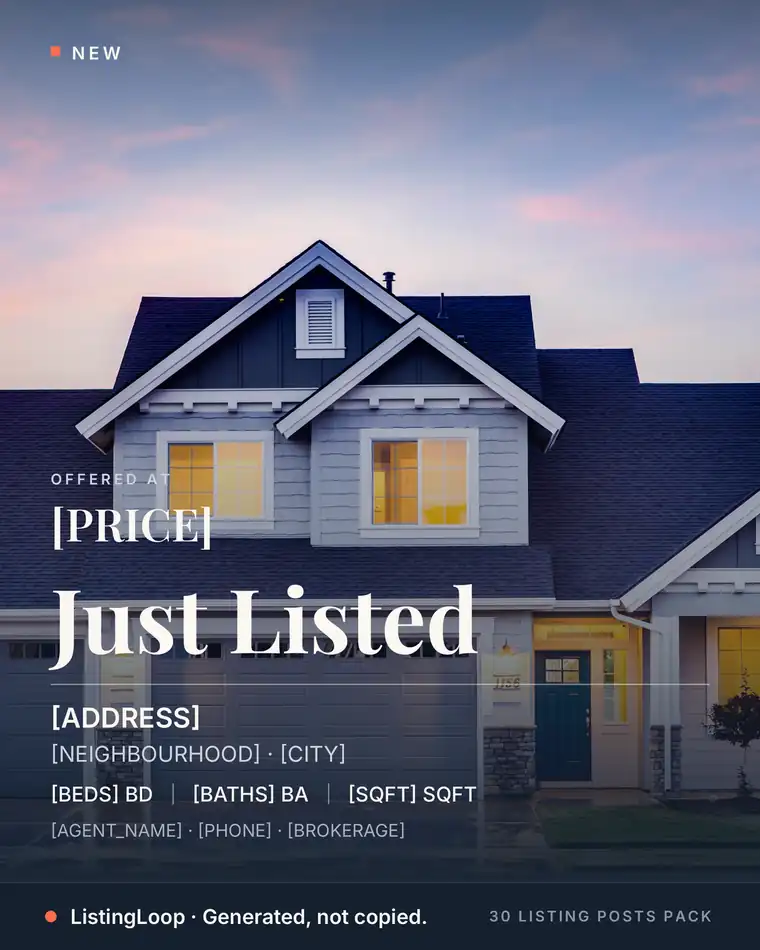
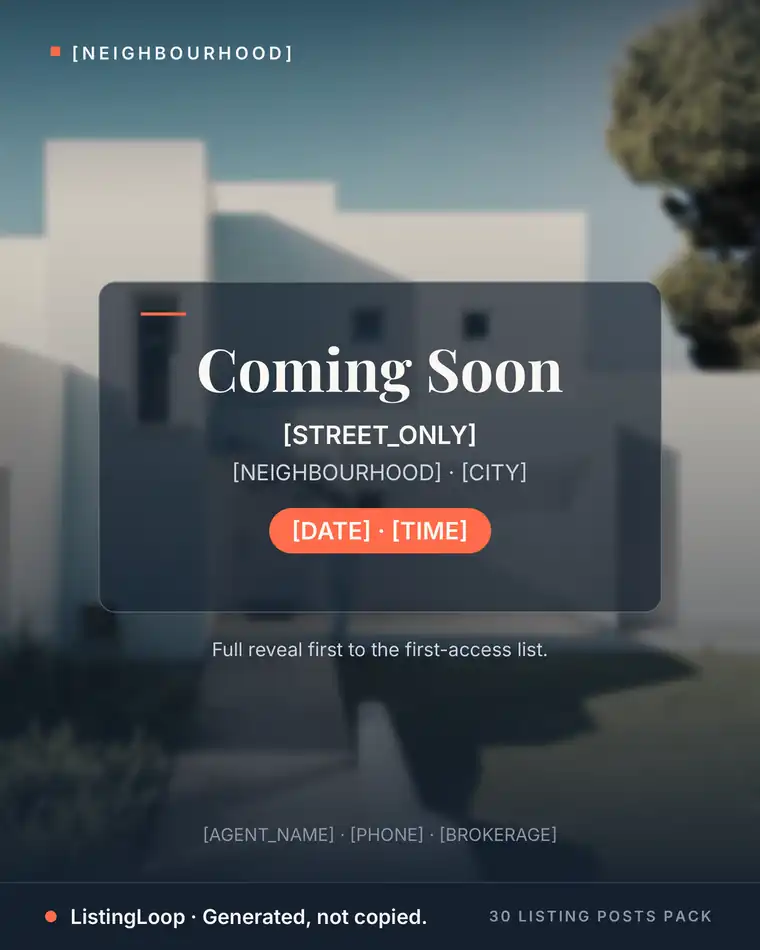
Try the free generator →In the 30 Listing Posts Pack, post 10 is the dual coming-soon / open house announcement and post 23 is the faceless open-house invite Reel — both with captions and posting prompts written. Run the sequence once with your next listing and compare the room to your last one-post open house. The difference is the campaign.
Frequently asked questions
How many open house social media posts should I publish for one event?
Six to eight touches for a single open house: an announcement, a feature teaser, a details post, a street invite and a last call before; a Story sequence during; and a recap, a second-chance post and a thank-you after. It sounds like a lot until you notice each one takes minutes — the sequence is written once and reused for every listing.
When should I post the open house announcement?
Three to five days before the event — Tuesday or Wednesday for a Saturday open house. Earlier and people forget; later and they have already made weekend plans. Follow it with the teaser two days out and the last call on the morning itself.
What should an open house post include?
A reason to come (the home’s best feature), the complete logistics (full address, day, date, time window) and exactly one call to action. Keep the call to action the same word on every post in the sequence — consistency is what turns six posts into a system instead of six interruptions.
What if nobody comes to my open house?
The sequence still earns its keep. The recap and second-chance posts are aimed at the much larger audience that saw the announcement and never came — they convert saves and profile visits into private tours during the following week. Judge the sequence on tour requests and DMs, not on the headcount alone.
Can I reuse the same open house posts for every listing?
Reuse the sequence, never the words. The structure — announcement, teaser, details, invite, last call, Stories, recap, second chance — is permanent. The captions get rewritten for each house, because the feature, the street and the deadline are the content. A copied caption announces that this listing isn’t special; the sequence exists to prove it is.
Before your next open house, choose your shortcut. The free Listing Post Generator drafts the announcement from your listing details in the same formula as every post above. Or take the sequence pre-built: in the 30 Listing Posts Pack, the open house announcement and invite ship as finished posts — graphic, caption, hashtags and posting prompt included — for $17 once. Run the sequence once and compare the room to your last one-post open house. The difference is the campaign.
Want the month done for you?
The 30 Listing Posts Pack: a full month of posts, finished graphic, written caption, hashtag set and posting prompt on every one. $17, one time. No subscription.
Want to use these examples with a real listing?
Create a draft