Scroll any agent feed for five minutes and you will spot the pattern. Captions that open with the same praise, describe every home the same way, and end with the same invitation to reach out. Much of it was written by AI, and much of it was posted without a second look. The problem is not the tool. The problem is the input. AI content works when it starts from something real. It fails when it starts from nothing, because it fills the gap with common words.
Answer, up front: use AI for drafts, variations, and outlines, and use yourself for facts, voice, and judgement. Give it a listing, a question, or a street. Edit by hand. Check every fact before posting. That division separates a post that sounds like you from a post that sounds like everyone.
Why most AI captions sound the same
An AI draft without details has nothing specific to say, so it reaches for safe, general language. Every home becomes stunning, every neighbourhood becomes vibrant, every agent becomes passionate. None of those words tells a buyer anything. Readers notice the pattern quickly. After the third identical caption, they stop reading and start scrolling.
Here is a simple test. Remove your name and your city from a draft. If the post still works for any agent in any city, it says nothing about your listing, your market, or your work. A good post should break when you remove the specific detail, because the detail is the point. Keep that test beside you for every AI draft you post.
The three inputs that make AI content usable
Give the draft one of these three inputs, and the output changes at once. Without one of them, do not post the draft. Rewrite it with an input first.
- •A real listing. Beds, baths, square footage, price, one feature that matters, and the showing detail. A draft built on those facts can still be wrong, so check it, but it starts from the home, not from a template.
- •A real question. A question a buyer or seller actually asked you this week, in their words where possible. The FAQ format works because the question is real, and the answer must help the person who asked it.
- •A real street. A neighbourhood, a commute, a park, or a local business you can name. Local detail proves the post was written for your city, not generated for any city.
A worked contrast shows the difference. A draft that says this beautiful home offers space, light, and comfort could describe thousands of homes. The same draft, edited with the listing facts, says the home has four bedrooms, a kitchen that seats six at the island, and showings on Saturday from 11 to 2. The second version is the only one a buyer can act on. Specifics are not decoration. They are the content.
What to generate, and what to write by hand
Generate the parts where speed helps and mistakes cost little: first drafts of listing captions, three versions of one hook, hashtag sets, outlines for a market explainer, and FAQ drafts from questions you collected. Our AI tools guide covers the tools that fit this slice, and the free Listing Post Generator does the listing version in one step, turning your listing details into three captions and five hashtag sets.
Write by hand, or check word by word, the parts where a mistake costs trust: prices, dates, availability, and showing times, any claim about a neighbourhood, a school, or a market trend, anything about a person, including a testimonial or a client story, and any sentence that describes who a home is for, which is where fair housing risk hides. Our fair housing safe captions guide sets out the property first rule: describe the property, not the people you imagine living in it.
The five minute edit that fixes most AI drafts
Do not rewrite the whole draft. Run this edit, in order, and most drafts become usable.
- •Add one detail only you know. A showing note, a question from a tour, or a feature buyers commented on. One detail beats ten adjectives.
- •Cut the generic praise. Delete stunning, vibrant, and passionate unless a fact earns the word. If the sentence still works without it, leave it out.
- •Check every fact. Price, beds, baths, dates, and any number. If you cannot verify it, delete it.
- •Read it aloud. If it does not sound like something you would say to a buyer at a showing, rewrite the sentence until it does.
- •End with one action. One clear next step: booking a tour, saving the post, or asking a question. Two actions in one caption is the same as none.
Where AI content fails, and what to do instead
Some jobs are a poor fit for an unchecked draft: market statistics with no source, price opinions, legal explanations, and promises about what a home will sell for. A draft that invents a statistic is not a small error. It is a false claim on your profile, under your name. Treat any unsourced number the same way: delete it, or replace it with a number you verified, with the source named in the post, as the Market Stat format does with its source line.
The same rule covers client proof. Never let a draft invent a testimonial, a sold story, or a result. If you have a real client story, write it yourself, with permission, and keep the details accurate. A feed with no testimonials is honest. A feed with an invented one is a trust problem that no amount of posting will fix.
A weekly AI workflow that stays honest
Put the system on a schedule, or it will not survive a busy week. Once a week, list your raw material: new listings, questions from showings and calls, and one local observation. Generate drafts for the listing posts first, because those have the hardest deadline, then edit them with the five minute edit above. Schedule the week using the cadence in our how often should realtors post guide and the day by day plan in our realtor weekly content system. Use the week to reply to comments, not to write posts.
Frequently asked questions
Can AI write my listing captions for me?
Yes, as a first draft, if you give it the listing facts and edit the result. A caption built from beds, baths, price, and one real feature, then checked by you, is usable. A caption built from no facts is a generic paragraph with your name on it.
Why does my AI content sound like every other agent?
Because it started with no specific input, so it used the most common language available. Add a listing fact, a real question, or a local detail, and cut the generic praise. The post should break if you remove your city and your name.
What should I never let AI write unchecked?
Prices, dates, availability, market statistics, legal explanations, and anything about a person, including testimonials. Check each word by word, and delete any claim you cannot verify.
How much editing does an AI draft need?
About five minutes for a caption: one detail added, praise cut, facts checked, one read aloud, and one clear action at the end. If a draft needs a full rewrite, the input was too thin.
Does using AI content hurt trust with buyers and sellers?
Unedited, generic AI content hurts trust, because readers recognise it and stop reading. Edited AI content, built on real facts and checked before posting, does not carry that problem. Trust comes from accuracy, not from whether a draft helped with the first version.
Three ways to use everything above. Start every AI draft from a listing, a question, or a street, and run the five minute edit before anything posts. Or skip drafting for listing posts: the free Listing Post Generator turns your listing details into finished captions, and the 30 Listing Posts Pack ships the whole month as finished posts, graphic, caption, hashtags and posting prompt on each, for $17 once. AI is the draft. You are still the agent.
Want the month done for you?
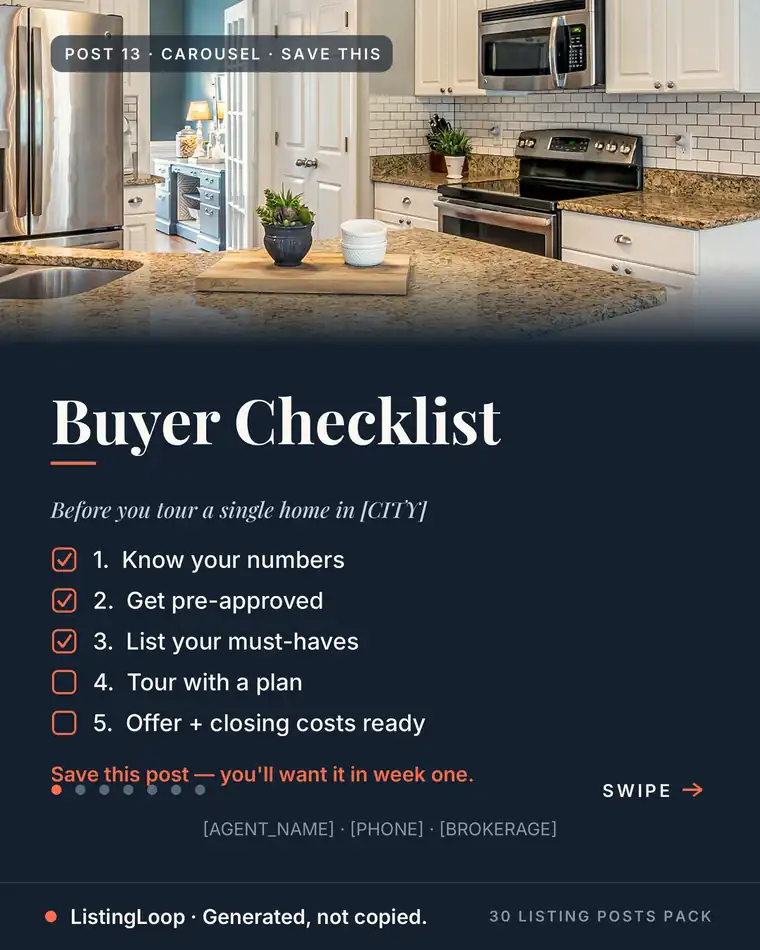
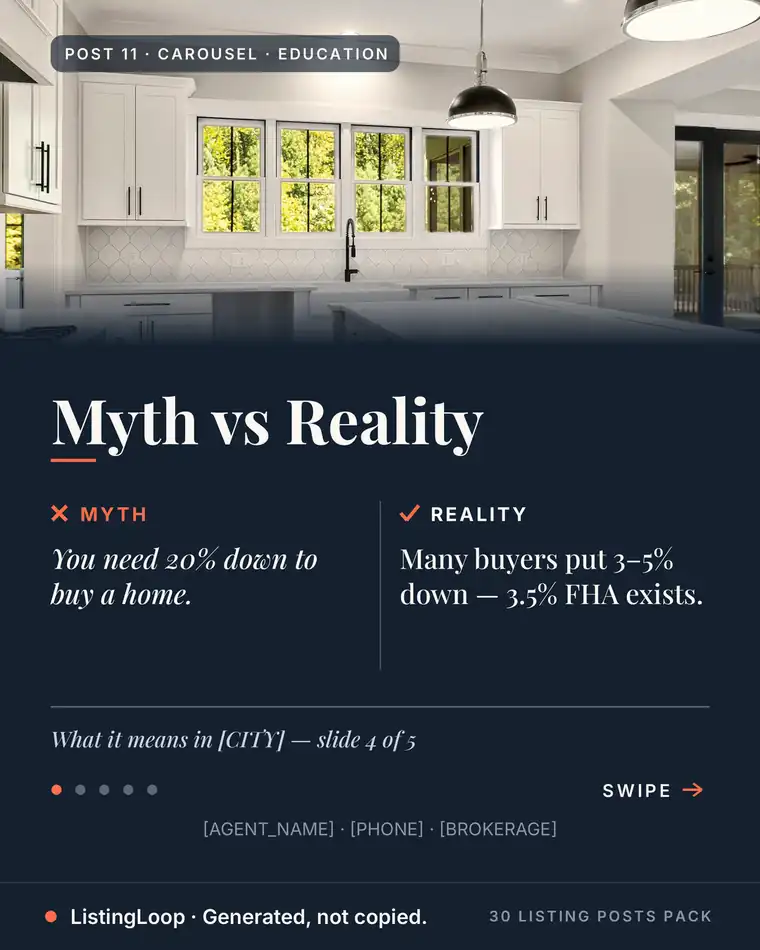
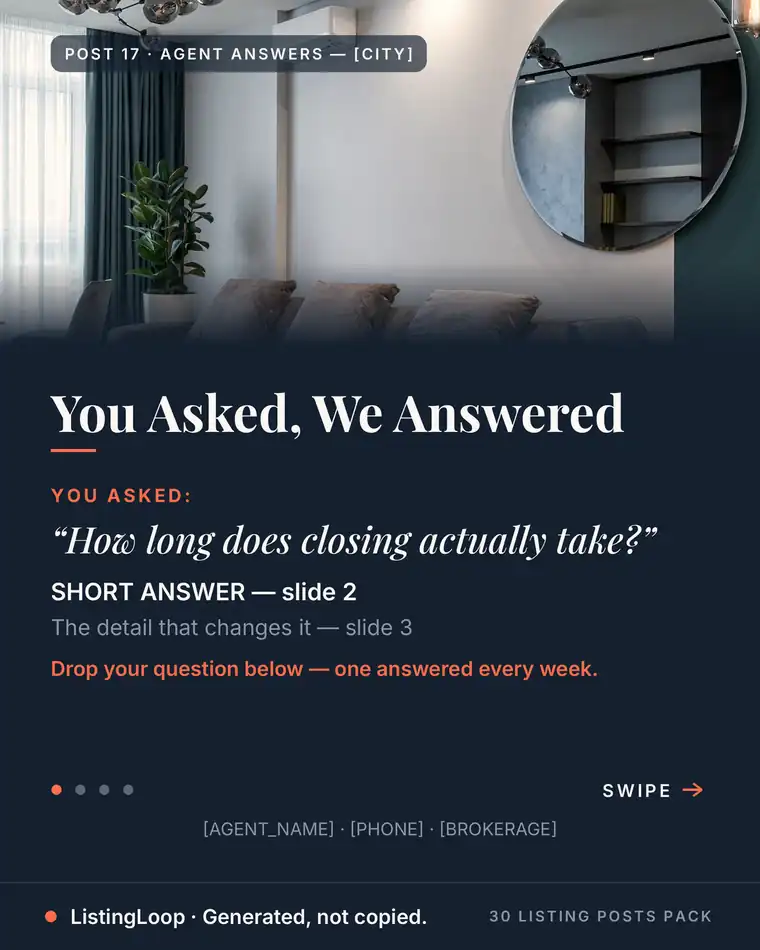
The 30 Listing Posts Pack: a full month of posts, finished graphic, written caption, hashtag set and posting prompt on every one. $17, one time. No subscription.
Want to use these examples with a real listing?
Create a draft