Most agent feeds do not fail for lack of effort. They fail for lack of a system. The agent opens the app, stares at a blank caption box, and posts whatever comes to mind, usually another listing photo. A week later the feed is five listing photos in a row, and the agent concludes that social media does not work. The planning failed, not the feed.
Answer, up front: use five pillars, listings, expertise, local, trust and conversation, and rotate them every week. Each pillar proves something different. Listings prove you have homes to sell. Expertise proves you know how a sale runs. Local proves you know the area. Trust proves other people have relied on you. Conversation proves you are a person, not a brochure.
What a content pillar is, and what it is not
A pillar is a job your feed must do, not a topic you post about once. Think of it as a shelf that always needs stocking: listings, expertise, local, trust and conversation. When a shelf stays empty for a month, visitors notice the gap, even if they cannot name it.
A pillar is not a hashtag, a posting day, or a content type. Video is not a pillar. Reels are not a pillar. Monday is not a pillar. Those are formats and slots. A pillar answers a different question: what does this post prove about me? If a post proves nothing, it does not belong on the feed, however pretty it looks.
The five pillars, and what each one proves
The five pillars below are the same five jobs used in our real estate social media post ideas guide and our realtor weekly content system. The calendar decides when each pillar posts. This article decides what each pillar contains.
- •Listings. Your homes, price changes, open houses and sold stories. Proof: you are active now.
- •Expertise. Pricing, preparation, offers and closing, explained plainly. Proof: you can guide a sale.
- •Local. Streets, businesses, events and area life, stated factually. Proof: you know this area.
- •Trust. Past results and client words used with permission. Proof: others have trusted you.
- •Conversation. Questions, polls and comparisons that invite replies. Proof: you listen.
Listings: prove you are active
The listings pillar is the easiest to fill and the easiest to overuse. Post each home, price change, open house and sold story once, with one clear next step. A listing post needs facts a buyer can act on: beds, baths, price, one real feature, and how to see it. The free Listing Post Generator writes that caption from your listing details.
Expertise: prove you know how a sale runs
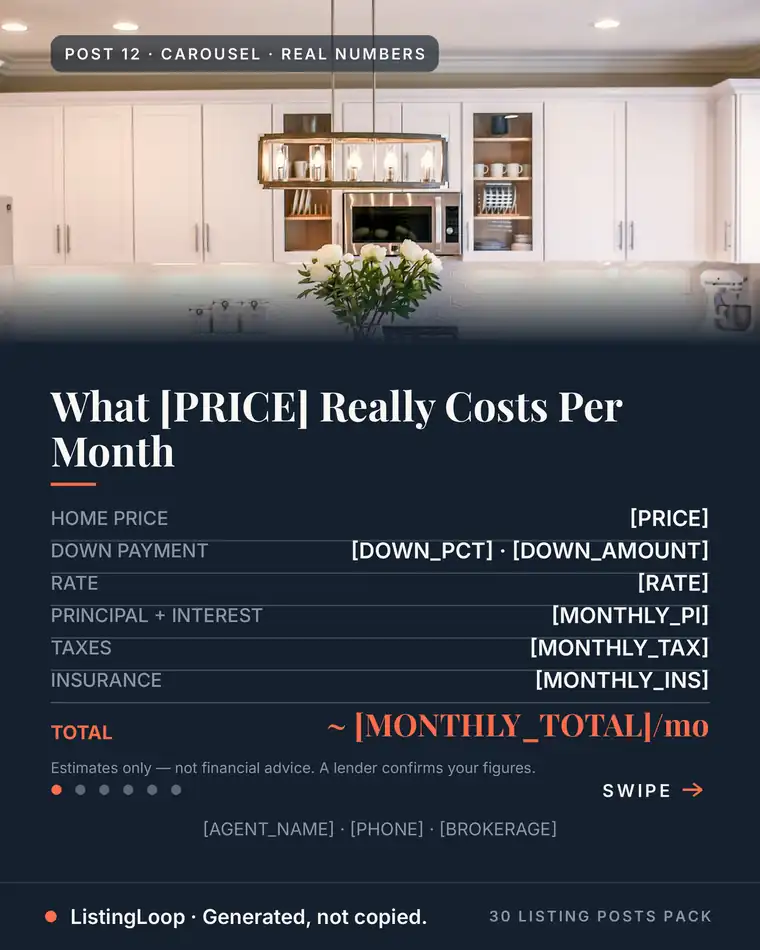
Expertise posts answer questions buyers and sellers ask in real life. What does a price really cost per month? What should a seller fix before photography? What happens after an offer is accepted? One question per post, answered plainly. The Affordability Breakdown format in the pack is the model: a real question and a worked answer.
Local: prove you know the area
Local posts show the streets you sell, not a generic city skyline. A neighbourhood spotlight, a market explainer for one area, a weekend preview, a local business you actually use. Keep every claim factual and verifiable: a street name, a measured distance, an event with a date. Describe the property and the verifiable facts, per our fair housing safe captions guide.
Trust: prove other people have relied on you
Trust posts are proof, not praise. A sold story with the seller's permission, a client sentence in their own words, a post about a problem you solved during a sale. Never invent a testimonial, a result, or a client story. A feed with no testimonials is honest. A feed with an invented one is a trust problem no posting will fix. If you are new, use process proof instead.
Conversation: prove you listen
Conversation posts ask something and wait for the answer. A comparison between two features, a poll on a local question, a prompt about a buying dilemma. The point is the replies, not the post. Reply to every comment in the first day, and turn the best replies into the next expertise post.

Skip the blank caption box
The free Listing Post Generator writes this exact kind of post from your listing details: your city, your numbers, your name, in about 20 seconds. Caption 1 is instant; all three captions plus hashtag sets unlock with an email.
Try the free generator →How to rotate the pillars across a week
Rotation turns five pillars into a feed. Assign each pillar a fixed day, then let listings jump the queue when a home launches, as our how often should realtors post guide explains. A three post week keeps the floor intact: one listings post, one expertise post, and one local, trust or conversation post.
- •Monday: expertise. Answer one buyer or seller question from last week.
- •Tuesday: local. One street, business, or area fact, stated plainly.
- •Wednesday: listings. The current home, price change, or open house.
- •Thursday: trust. One proof post, with permission where a client is named.
- •Friday: conversation. One question, poll, or comparison, then reply.
Fill each pillar from real work, not from inspiration
Inspiration is the worst source of post ideas, because it arrives when you are free and vanishes when you are busy. Real work is a better source, because it never stops arriving. Every showing, call, and client question is raw material for a pillar. Collect it during the week and turn it into posts in one batching session.
- •Listings material: new homes, price changes, open house dates, sold stories.
- •Expertise material: questions from showings, calls, and client messages.
- •Local material: streets you drove, businesses you visited, events noticed.
- •Trust material: problems solved, launches prepared, clients who agreed to a post.
- •Conversation material: dilemmas and questions clients actually debate.
The mistakes that break a pillar system
Four mistakes break pillar systems: listings taking over, expertise no one asked for, trust without permission, and questions with no replies. Each one is fixed by returning to the pillar's job: what does this post prove?
- •Listings only. Cap listing posts at two per week unless a launch demands more.
- •Lectures instead of answers. One question, one plain answer, one next step.
- •Proof without permission. No client name, photo, or words without a clear yes.
- •Questions without replies. Answer every comment in the first day, or stop asking.
Frequently asked questions
What are content pillars for a realtor?
Content pillars are the small set of jobs a feed must do, week after week. For most agents, five pillars cover the feed: listings, expertise, local, trust and conversation. Each pillar proves something different.
How many content pillars should a realtor have?
Five is the working number. Fewer than four leaves a visible gap, usually trust or local, and followers notice it. More than six becomes hard to rotate, and pillars start repeating each other.
What if I have no listings for the listings pillar?
Do not fake it. Fill the week from the other four pillars: an expertise answer, a local spotlight, a process post, and a conversation question. Past sold stories also count as listings proof, because they show homes you have actually sold. New listings return, and the feed stays full until they do.
How do content pillars differ from a content calendar?
Pillars decide what a post must prove. A calendar decides when it posts. The pillars come first, because a calendar without pillars just schedules the same kind of post every day.
How long should I run a pillar system before judging it?
Four full weeks. A month shows whether the rotation holds through a busy week, whether each pillar gets its turn, and whether replies, saves, or inquiries follow. If the schedule holds but response is flat, change the topics inside the pillars before changing the pillars themselves.
Three ways to use everything above. Pick your five pillars and assign each one a fixed day. Or skip the writing for the listing posts: the free Listing Post Generator turns your listing details into finished captions, and the 30 Listing Posts Pack ships the whole month as finished posts, graphic, caption, hashtags and posting prompt on each, for $17 once. The pillars are the system. The posts are the part you no longer have to invent from scratch.
Want the month done for you?
The 30 Listing Posts Pack: a full month of posts, finished graphic, written caption, hashtag set and posting prompt on every one. $17, one time. No subscription.
Want to use these examples with a real listing?
Create a draft